


Executive Summary
Despite its century-long history, the executive search industry has remained largely unchanged in its fundamental processes. As global business environments continue to transform and grow, the core approach to identifying and placing executive talent has followed patterns established by early pioneers from consulting firms.
Today, as artificial intelligence revolutionizes industries across the board, the talent acquisition field stands at an inflection point. AI offers transformative potential to address longstanding challenges in leadership talent acquisition. This article explores how AI technologies fundamentally reimagine the executive search process while ensuring the human element remains central to effective executive talent acquisition, providing organizations a competitive advantage to secure leadership talent.
The Evolution of Executive Search
The executive search industry traces its origins to the aftermath of World War I, when Lincoln Filene, president of the Retail Research Association, commissioned Thorndyke Deland to direct executive search activities for member department stores. By 1926, Deland established the Thorndyke Deland firm, focused on recruiting executives for major retail companies.
Many of today’s prominent executive search firms emerged during the 1940s through the 1960s. The methodologies they adopted were further influenced by management consulting firms like McKinsey and Booz Allen, which established practices that have remained relatively unchanged for nearly 100 years. While the industry has expanded globally, and despite significant changes in global business environments, leadership requirements, and technological capabilities, the fundamental approach to identifying and selecting executive talent has followed the same patterns.
For C-suite leaders, this persistence of traditional methods creates tangible business risks. In a business environment where leadership decisions have never been more critical, relying on century-old approaches creates unnecessary challenges as you take your most important talent decisions.

Opportunities for Transformation
Organizations today face unprecedented challenges in identifying and securing the right executive talent. These present opportunities for transforming the existing executive search process:
Speed to hire has become increasingly critical, with vacant executive positions costing large organizations an estimated $1-3 million per month.
Consistency across global operations directly impacts the ability to build cohesive
international leadership teams.
Data-driven decision making, though embraced in most business functions, remains elusive in executive hiring.
Objective candidate evaluation continues to be challenged by inherent biases and inconsistent interview approaches
Traditional talent acquisition methodologies, while proven, have limitations in addressing these contemporary challenges. The industry has been ripe for innovation that preserves the high-touch, consultative value while streamlining and enhancing processes through technology.
AI as the Catalyst for Industry Transformation
The executive talent acquisition industry is only now beginning to leverage the transformative potential of artificial intelligence. Unlike point solutions or legacy systems retrofitted with AI capabilities, next-generation platforms are being architected from the ground up to integrate artificial intelligence throughout the entire search process.
Kingsley Gate was built on the prescient belief that artificial intelligence would fundamentally transform executive recruitment. This vision, established eight years before ChatGPT introduced generative AI to the mainstream, has guided the firm to address the above challenges with the industry’s first end-to-end talent platform with artificial intelligence at its core. Our platform addresses key challenges through several innovations:
Enhanced Role Definition and Search Strategy
Traditional approach: Days or weeks developing position specifications and search strategies based on limited market data
AI-enabled approach: Our platform assists consultants and clients in precisely defining roles and developing comprehensive search strategies tailored to specific organizational needs and market realities. AI-powered analytics help identify the most relevant candidate characteristics and potential sources of talent.
Data-Driven Candidate Identification
Traditional approach: Candidate identification is limited by the recruiter’s network and manual research capabilities.
AI-enabled approach: Our technology develops long lists of candidates with detailed rationale for their inclusion, moving beyond traditional network-based approaches to a more systematic identification of potential leaders based on quantifiable criteria.
Standardized Yet Personalized Assessment
Traditional approach: Inconsistent interview processes and subjective evaluations across different interviewers
AI-enabled approach: While different talent acquisition specialists and hiring managers naturally have varied interviewing styles, Kingsley Gate’s approach provides structure without sacrificing the human element that remains essential to talent acquisition. Additional intelligence on how candidates will make decisions in specific business environments, helps predict performance where it matters most.
Streamlined Stakeholder Feedback
Traditional approach: Cumbersome collection and inconsistent synthesis of feedback from multiple stakeholders
AI-enabled approach: Simplified feedback process enabling leadership teams to provide meaningful input with minimal effort, ensuring comprehensive perspectives to inform hiring decisions.
Reference Optimization
Traditional approach: Reference value dependent on individual skill and volume of calls or length of reports, with limited contextual analysis
AI-enabled approach: Reference intelligence that contextualizes reference data against specific hiring requirements, creating a more objective and comprehensive view of candidates.
Improved Onboarding Integration
Traditional approach: Limited support after placement, with onboarding treated as a separate process
AI-enabled approach: Intelligence extends beyond hiring to optimize onboarding, increasing successful leadership transitions, and reducing time-to-effectiveness.
Strategic Implications for
Organizations
The AI transformation of executive search offers significant advantages:
Competitive Talent Advantage: Bridging blockchain innovation with traditional finance standards
Risk Reduction: Data-informed selection reduces the likelihood of costly executive hiring mistakes
Accelerated Impact: Faster search completion and enhanced onboarding mean new executives
deliver higher performance faster
Decision Strategy Alignment: Decision intelligence ensures a comprehensive understanding
of how executives will succeed in specific business environments
Enhanced Diversity: AI helps identify qualified candidates beyond traditional networks,
supporting diversity objectives
The World Economic Forum emphasizes that C-suite executives must possess a deep understanding of AI’s technical, organizational, regulatory, and societal dimensions to steward responsible adoption and value creation
AI as a Core Responsibility Across
the C-Suite
This evolution of AI capabilities not only transforms how executive talent is acquired but also reshapes the criteria for evaluating executive candidates themselves. As organizations increasingly depend on AI for competitive advantage, executive search must now assess AI fluency across all leadership roles.
A BCG report underscores a fundamental shift: every C-suite leader, not just the Chief AI Officer (CAIO), must now act as a steward of AI within their domain. This means that AI leadership is no longer siloed but distributed, requiring each executive—CEO, COO, CFO, CHRO, CIO, CISO, and others—to integrate AI strategy, risk management, and value realization into their core responsibilities.

CEO: Ensures the organization realizes the full business value of AI while maintaining customer trust and responsible use. The CEO must align product, legal, and security teams throughout all phases of AI deployment and establish a formal operating model for AI security and privacy.
COO: Aligns AI use cases with business objectives and ensures resilient, secure implementation. The COO is responsible for operational structures and capability-building to support AI-enabled operations.
CRO & CISO: Directly manage AI-related risks, balancing innovation with robust controls. They must develop security strategies, update governance guidelines, and ensure compliance with evolving regulations.
CFO: Manages the financial impact of AI investments, negotiates contracts with AI vendors, and ensures that cost, value, and security considerations are embedded in AI procurement and deployment.
CHRO: Overseas training and policy development to ensure the workforce is equipped for responsible AI adoption.
“Organizations should learn from the early days of cloud adoption, avoiding a fragmented, uncoordinated rush into AI. Instead, they should move with ‘deliberate speed,’ ensuring strong governance, cross-functional collaboration, and a well-resourced AI center of excellence. This approach prevents the chaos and security risks that characterized earlier technology migrations and ensures that AI adoption is both responsible and effective.”
— Boston Consulting Group

The Human-AI Balance: People
Remain Central
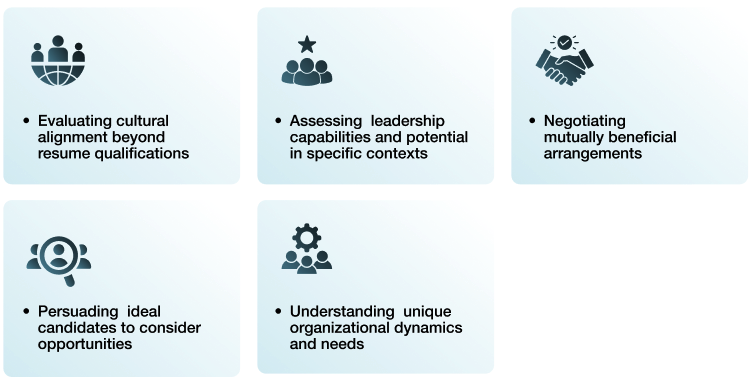
Despite technological advancements, the human element remains central to executive search. The most effective AI platforms recognize that people will never be completely removed from the process. Rather, they remove administrative burden from consultants, allowing them to focus on high-value activities:



Conclusion
The search industry is only now beginning to leverage the transformative potential of artificial intelligence. As AI continues to evolve executive talent acquisition, organizations that embrace these innovations gain significant advantages in building their leadership teams. By reducing time-to-hire without sacrificing quality, providing more consistent processes while preserving the human element, and enabling more data-informed decisions while respecting the importance of judgment and relationship, AI positions the talent acquisition industry for its next century of evolution.
This transformation extends beyond merely improving search processes. Executive search must now assess AI fluency and strategic leadership across all C-suite roles, not just technical positions. Every candidate should demonstrate an understanding of AI’s business impact, risk landscape, and governance requirements. Given the heightened focus on responsible AI, executive assessments must increasingly include experience with AI governance, risk management, and ethical deployment frameworks.
As organizations continue to navigate increasingly complex talent landscapes, those that embrace these innovations will gain significant advantages in building their leadership teams. The most forward-thinking organizations are already implementing AI-enhanced executive search approaches, creating a competitive talent advantage that directly impacts business performance. The future belongs to those who can effectively balance technological innovation with the irreplaceable human elements of leadership selection.

 English
  Español de México