


About our research
Kingsley Gate commissioned a survey that was conducted by FT Longitude in September 2023.
We spoke to senior executives at C-suite, C-1 and C-2 levels from 13 industries and six countries across Latin America: Argentina, Brazil, Chile, Colombia, Mexico, and Peru.
This is a comparative study of research carried out in May and June 2023, which surveyed senior executives at C-suite, C-1 and C-2 levels from 13 industries in Singapore, Spain, the UAE, the UK, and the US. We refer to this sample as “other international markets”.
People make more of a difference between good and bad decision making than tech or data
LATAM senior executives in our research reveal that, put together, the decision-making capabilities of some key individuals are the main driver of better decision making in organizations.
Senior executives were asked to reflect on the improvement in their organization’s decision making during their time at the company and consider what has played the biggest role in driving this
improvement. The most influential factors were company leadership and new employees. These were followed by their own personal, self-reported impact, and then by other existing employees.
These people-centric factors rank ahead of technology, processes, data-analysis tools, and economic factors – a trend also reflected in other international markets.

And when LATAM senior executives were asked to name the main factor in time-wastage in decision making at their organization, answers were most likely to relate to inexperienced decision-makers or poor leadership. This highlights that people can both positively and negatively impact decision making within an organization.
So, employing experienced decision makers at leadership level helps decisions to be made effectively with minimal time-wastage. And for LATAM senior executives, faster decisions are the top way to increase their satisfaction with their organization’s decision-making effectiveness.
Recruiters in LATAM should discuss decision making with prospective senior executives during the hiring process. Assessing the candidate’s decision-making ability and style will help the organization to hire good decision makers, and our research shows that good decision makers minimize time-wasting and improve decision making in the company overall.
Empowerment and autonomy encourage progress but could cause friction

Two-thirds of LATAM respondents are satisfied with how empowered they are to make decisions in their role. This compares with only 58% of respondents in other international markets. Empowerment is clearly important to LATAM senior executives: 79% say they have resigned or considered resigning because they did not feel empowered to make good decisions. In other international markets, it’s only 63%.


C-Suite are the most likely seniority level to think their company style align with their own – although less than half (43%) C-2 are the least likely to say this – only 32% say their style aligns
- 37% say their decision-making style aligns with their organization’s style
- 28% say their decision-making style conflicts with their organization’s style
The empowerment, autonomy and authority that LATAM senior executives possess could indicate that they are allowed to make decisions their own way, separate from the decision-making style of the company overall. Equally, this lack of alignment could suggest that conversations about decision making in interviews are too superficial; executives are not aware of the organization’s style; and executives have been hired to introduce a different approach.
Interestingly, the LATAM senior executives who have the most decision-making authority within their area of responsibility—at a departmental level and an organizational level—are most likely to say their style of decision-making conflicts with their organization’s. Executives with more authority may be required to challenge the status quo with a different approach to decision making. Again, this could simply indicate that they are given the authority and autonomy to make decisions their own way, separate from the decision-making style of others.
Discussing decision making during the hiring process will allow companies to assess whether a senior executive can bring in a different approach in a respectful way that doesn’t lead to friction. It will also help the candidate to understand whether they need to challenge the status quo—and how to go about it.
1 Aminov, I., De Smet, A., and Jost, G. (2019). Decision making in the age of urgency. McKinsey & Company. https://www.mckinsey.com/capabilities/people-and-organizational-performance/our-insights/decision-making-in-the-age-of-urgency
Empowerment and autonomy encourage progress but could cause friction
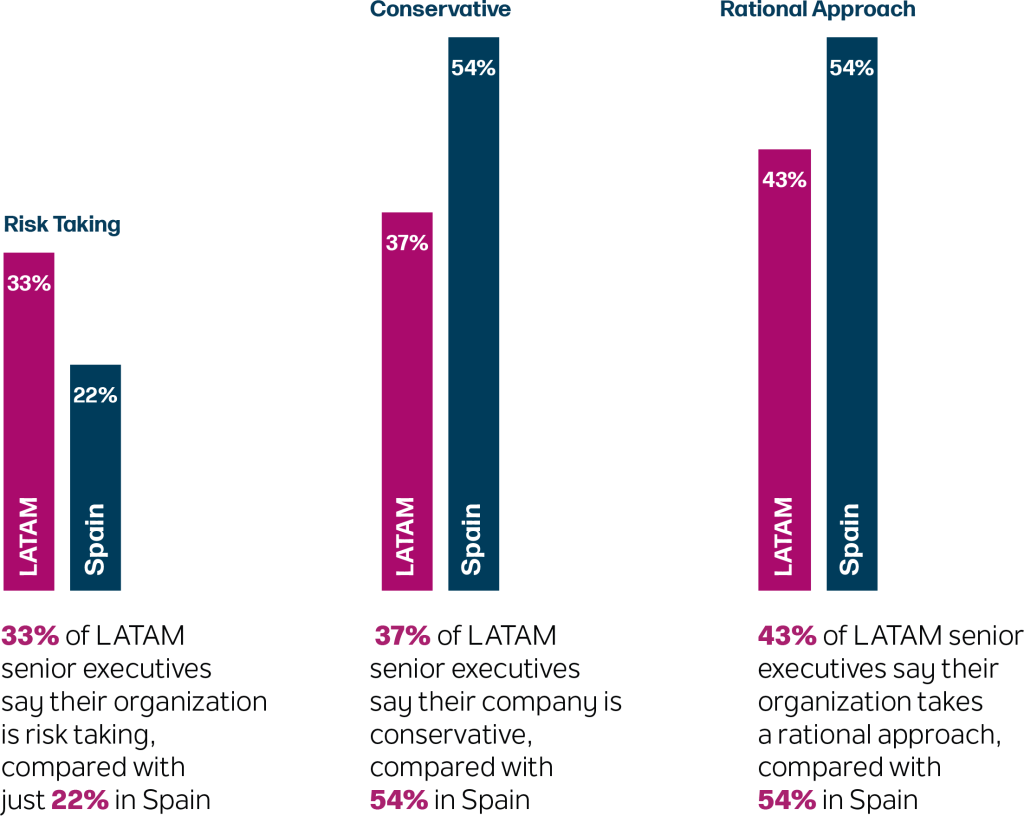
These findings are consistent with Hofstede Insights’ Country Comparison Tool,2 which shows that uncertainty avoidance is prevalent in Spain—more than in Latin American countries such as Brazil and Mexico.

These findings are consistent with Hofstede Insights’ Country Comparison Tool,2 which shows that uncertainty avoidance is prevalent in Spain—more than in Latin American countries such as Brazil and Mexico.
Variation in organizational decision-making styles between regions reinforces the idea that organizations and candidates need to discuss decision making before a job offer is made. This is especially true when interviewing candidates who may have worked in other countries or who may need to collaborate with international stakeholders, as there could otherwise be unforeseen implications.
2 Country Comparison Tool. Hofstede Insights. https://www.hofstede-insights.com/country-comparison-tool?countries=spain
Latin American companies show us why decision-making skills and styles should be part of executive hiring

LATAM senior executives are more likely than other international markets to:
Have been asked about decision making in their interviews
Be satisfied with their organization’s decision-making effectiveness
Be satisfied with how empowered they are to make decisions
Have decision-making autonomy
Be happier with their job overall





 English
  Español de México